
Clarendon County VINELink Coverage
South Carolina brands the network SC VINE. The Clarendon County Detention Center calls the same service SAVIN and expressly confirms local participation. That local statement matters. It means a Clarendon County jail record can supply status and custody-change notices, including release and transfer, rather than participation being inferred from statewide marketing.
The SC VINE service also receives data from SCDC and SCDPPPS. Its official FAQ describes feeds from 43 county detention centers, two work camps, two city jails, the state prison system, and the supervision agency. Source data are collected about every 15 minutes. That interval is not a guarantee that every event appears at once, and it is not a Clarendon jail-roster refresh rate.
Service is free and continuously available, with English and Spanish access and operator language help. It supports searches and confidential registration. The person named in the custody record cannot view who registered.
- VINE
- A custody and supervision information and notification network.
- SAVIN
- The statewide automated victim information and notification name used by Clarendon County.
- Custodian
- The jail, prison, supervision agency, or other authority responsible for the reported record.
- Transfer
- A move to another custodian, which is not the same as community release.
Search Clarendon County VINELink Records
Search one person at a time. Begin at the official South Carolina VINELink portal, select the People or offender search, and use the strongest identifier available. A common name alone is not enough. Middle initial and date of birth can help distinguish similar results.
- Open the South Carolina state portal and choose the person search.
- Enter the full name or offender number. Add the middle initial or birth date when available.
- Compare identifying details and choose only the record that matches the intended person.
- Open the record and read the reporting agency, location, custody or supervision status, and event wording.
- Note whether the event says release, transfer, custody, or supervision and record its displayed time.
- If no record appears, call 1-866-727-2846 and then contact the likely custodian.
- Confirm the event with CCDC, SCDC, SCDPPPS, or the receiving agency as appropriate.
A full search across county, state, and federal systems is available through the Clarendon County released-inmate search. VINELink itself should stay focused on the selected person and future notices.
Clarendon County VINELink Release Fields
A selected VINELink record can provide the fields needed to interpret an agency-reported change. Availability varies by reporting source, so read the displayed labels as written. Do not supply a missing legal reason from guesswork.
| Field | Careful interpretation |
|---|---|
| Name or offender number | Helps match the alert to the correct person. |
| Custody or supervision status | States the source system's reported condition. |
| Agency or location | Identifies who supplied the record or held the person. |
| Event type | Distinguishes release, transfer, custody, or supervision change. |
| Displayed event time | Marks the reported event, not necessarily alert receipt time. |
| Notification options | Shows which contact channels can be tied to the record. |
A release change is affirmative evidence that the source agency transmitted that event. It may not state the court disposition, detainer result, destination, sentence completion, or end of supervision. Obtain those facts from the agency or court record.
The official VINELink interface provides the person search and registration flow.
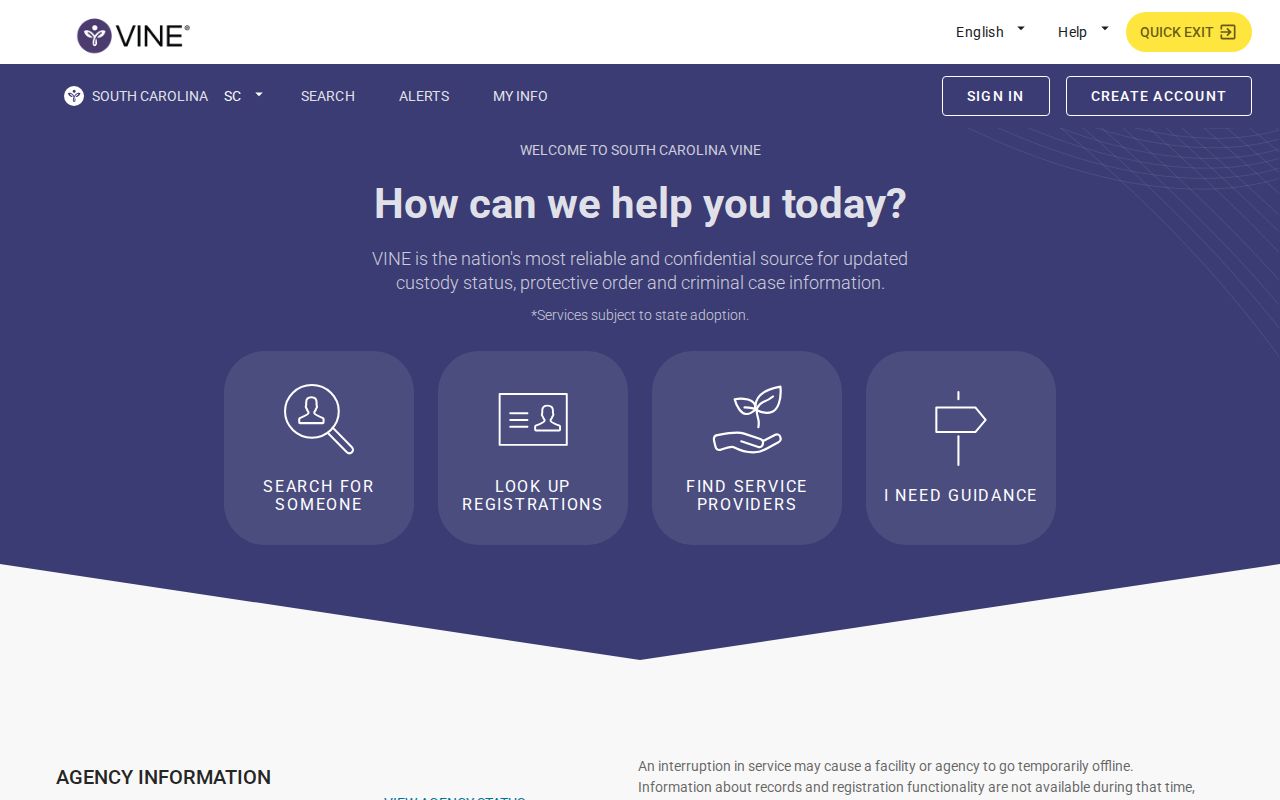
The captured interface shows the proper person-specific route, which must be matched to the right identity before alerts are registered.
Note: Alert receipt time can follow the physical event, so it should never be relabeled as the exact release time.
Register Clarendon County Release Alerts
Registration must begin from the exact matching record. VINELink may offer automated telephone, email, SMS or text-capable phone, and TTY routes. Select the channel that can be kept current. Registration is confidential, and the offender does not see the registrant.
- Search for and select the correct Clarendon County or South Carolina record.
- Choose registration or notifications from that individual record.
- Select phone, email, SMS, or TTY when the option is offered.
- Enter and confirm the requested contact information.
- For automated phone calls, create or retain the four-digit PIN used to hear and acknowledge the message.
- Follow the on-screen confirmation for email or SMS, which does not use the phone PIN.
- Save the confirmation and update contact details if they change.
Automated phone calls can repeat for up to 48 hours until the PIN is entered. That PIN is for access and acknowledgement of the recorded message. It does not verify identity or change a custody record. Email and SMS notices follow their own on-screen confirmation process.
Clarendon County VINELink Release Limits
VINELink does not cover every person or custody system. The FAQ identifies limits involving juveniles, adults on bond or otherwise out of custody, and certain placements. A missing record may reflect scope, timing, transfer, spelling, or identity mismatch. It cannot by itself prove release.
Federal BOP custody is outside VINELink and must be checked through the BOP Locator. ICE custody uses the ICE locator. A USMS pretrial movement may require the federal docket or records because there is no public USMS locator. These systems should not be merged into a single status claim.
For CCDC, call Booking & Release Information. For a completed SCDC prison discharge, compare the event with the separate SCDC Released Inmate Search. For parole, probation, community supervision, or supervised reentry, SCDPPPS is the authority. Each check answers a different part of the custody story.
Clarendon County SAVIN Participation
Clarendon's detention page makes the local layer concrete. It states that detention centers, SCDC, and DPPPS supply status and that registered users can receive custody changes, including transfer and release. Assistance is available around the clock through 1-866-SCSAVIN, which is the same 1-866-727-2846 number.
That participation does not turn VINE into an official release certificate. It makes the alert a strong lead tied to a participating source. For a CCDC event, ask whether the person entered the community or moved to another agency. For an SCDC event, read release type in the state released list. For supervision, check SCDPPPS.
Note: Clarendon County calls the service SAVIN, while the statewide public portal uses SC VINE and the VINELink interface.
Clarendon County Transfer Re-Registration
A transfer from CCDC to SCDC changes the reporting agency and may require a new notification registration. The first alert may correctly say that county custody changed, yet the person remains confined in the state system. Search the new SCDC record, confirm the identifier, and register again when the interface or FAQ directs it.
The same caution applies to another county or custodial agency. Preserve the first alert, note the receiving agency, and follow the person only through the verified matching record. Never assume that a county release alert means freedom from all custody.
Clarendon Release Notification Channels
Public VINELink registration and SCDC Victim Services are complementary but distinct. The public may register on a matching VINELink record without describing a protected relationship. SCDC crime victims who need the agency's separate statutory notification process can contact SCDC Victim Services at 1-800-835-0304.
VINELink is also not an emergency service or a guarantee of personal safety. In an immediate emergency, use emergency services. For a records question, contact the record holder. For a custody change, retain the notification and confirm it with the source agency.
The agency record supplies the context an alert may omit. CCDC can explain whether an official court document covered all charges, whether a warrant or detainer changed the destination, and whether physical processing ended. The Public Index can show judicial action, but not the exact gate moment. Reading those sources together is stronger than treating one automated message as a complete release record.
State-prison events have their own chain. The SCDC current search is for people still incarcerated in SCDC and excludes former prisoners. The separate Released Inmate Search provides the completed release date and release type. SCDPPPS then addresses parole, probation, community supervision, or supervised reentry. VINELink can notify across those changes, but it does not replace the official record of each agency.
A record may disappear after supervision ends or may not appear because the person is outside a covered category. Search again with the offender number and a careful name form. Call the VINE assistance line if the interface gives no clear match. Then call the likely custodian instead of relying on the FAQ's statement that an absent adult record may suggest release.
Keep the notification channel current. A disconnected phone, full mailbox, filtered email, or changed number can prevent practical receipt even when registration remains tied to the record. Save the confirmation, keep the phone PIN private, and recheck after an agency transfer. A new reporting source may require a new registration even when the person is the same.
Finally, distinguish notice from proof of destination. “Released” may describe the reporting agency's custody change. It does not necessarily mean all legal control ended. Parole and supervised reentry continue under SCDPPPS. A detainer can lead to another custodian. Confirmation should state who released the person, when the event occurred, what type was reported, and where the person went next.
If a record has common-name matches, do not register on all of them merely to see what happens. Compare the offender number, middle initial, birth date, agency, and location first. An alert tied to the wrong person creates confusion and does not become reliable through repetition. Where identity remains uncertain, contact the source agency with the available identifiers before registering.
Keep a simple event log after registration. Record the source record, registration channel, confirmation date, alert wording, and the agency answer obtained during verification. That sequence makes it easier to separate the reported event time from the time a call, text, or email arrived.