
Clarendon Projected Versus Actual Release
A projected release date is a calculation for a person still serving a sentence. SCDC records also use “projected maxout date,” which estimates the end of the custodial term under the applicable computation. Neither phrase says the person has walked out. By contrast, a Release Date in the separate SCDC Released Inmate Search reports a past state-prison event. A completed CCDC release entry serves that role for the county jail.
Pretrial detainees at the Clarendon County Detention Center do not have a sentence-based projected date. Their possible departure depends on a court document covering every charge, satisfaction of bond terms, and clearance of warrants or detainers. A detainer is another agency's request that may lead to continued custody or transfer. Even after court action, CCDC must complete release processing.
Find Clarendon Inmate Release Dates
Start by identifying the custodian. The current SCDC inmate search covers people now in state prison and commonly displays confinement data and a photograph. It excludes county detainees and former SCDC prisoners. The separate released search is for completed state-prison departures. A person at CCDC requires the jail and court route. Mixing these systems is the most common source of a false date.
- Confirm whether the person is at CCDC, Turbeville Correctional Institution, another SCDC prison, or another agency.
- For a current SCDC prisoner, use the SCDC current search and copy the SCDC ID and exact projected or maxout label.
- Compare the sentence and orders in the Clarendon Public Index. Note concurrent or consecutive terms and credit for time served.
- Call SCDC Inmate Records at 803-896-8531 for the official current state calculation.
- For a CCDC local sentence, call Booking & Release Information at 803-435-8831 or 803-435-0697 and request the local computation or release record.
- After the date passes, use the SCDC Released Inmate Search or CCDC confirmation to prove the event.
The Clarendon County released inmate search paths also separate court action, county release, state discharge, and transfer.
Clarendon Release Credit Rules
A sound calculation begins with the imposed custodial term, applicable time-served credit, and whether multiple sentences run at once or one after another. It then identifies mandatory minimums and the offense category before applying credits. South Carolina does not use one simple percentage for every prisoner.
Under South Carolina Code Title 24, Chapter 13, Section 24-13-100 defines the covered “no parole offense” category. Section 24-13-150 generally bars early release, discharge, or community supervision for such an offense until at least 85 percent of the actual term is served, subject to statutory exceptions. Credits cannot reduce the term below that floor. This rule must not be extended to every offense.
Section 24-13-210 generally provides an otherwise eligible SCDC prisoner 20 days of good-conduct credit per month when conduct standards are met. A no-parole prisoner generally receives three days per month under a distinct rule that preserves the floor and excludes specified cases. Misconduct can cause forfeiture. Section 24-13-230 allows discretionary work or education credits within its limits, while Section 24-13-175 calls for a 365-day year.
Local confinement has its own rule. Section 24-13-210(C) generally allows one day of deduction for every two days served by a person sentenced to a local detention facility who follows the rules. The local official can forfeit credit. This applies to a local sentence, not a pretrial bond question.
Why Clarendon Release Dates Change
A forecast can move in either direction as the record changes. The date calculator is not a substitute for the computation sheet. A change does not prove an error, and a past forecast should not be copied as if it remained current.
| Factor | Possible effect | Source to confirm |
|---|---|---|
| Credit earned or forfeited | Moves a projected date earlier or later within legal limits | SCDC or CCDC computation record |
| Jail-credit correction | Changes credited time already served | Court order and records office |
| New, vacated, or amended sentence | Changes the term or how terms combine | Court docket and commitment papers |
| Detainer or warrant | May change destination, not sentence end | Current custodian and receiving agency |
| Parole result | May permit conditional early release or continue custody | Board result, SCDC, and SCDPPPS |
| Record correction | Updates calculation inputs | Agency computation sheet |
Parole eligibility runs on a separate clock. Section 24-21-610 generally uses one-fourth for eligible nonviolent offenses and one-third or a longer mandatory minimum for eligible violent offenses, with ten-year and offense-specific rules. No-parole offenses do not enter the ordinary parole process. Eligibility is a first possible hearing point, not a promised departure.
Confirm Clarendon Actual Release Dates
For state prison, search the completed date in the SCDC Released Inmate Search. Its observed fields include SCDC ID, name, sex, race, age, sex-offender indicator, Release Date, Release Type, and County. Export data can include SID, victim and detainer indicators, and the most serious offense. “County” is not proof that the person left through a Clarendon jail gate.
The official released-inmate instructions describe the state-prison search shown below.
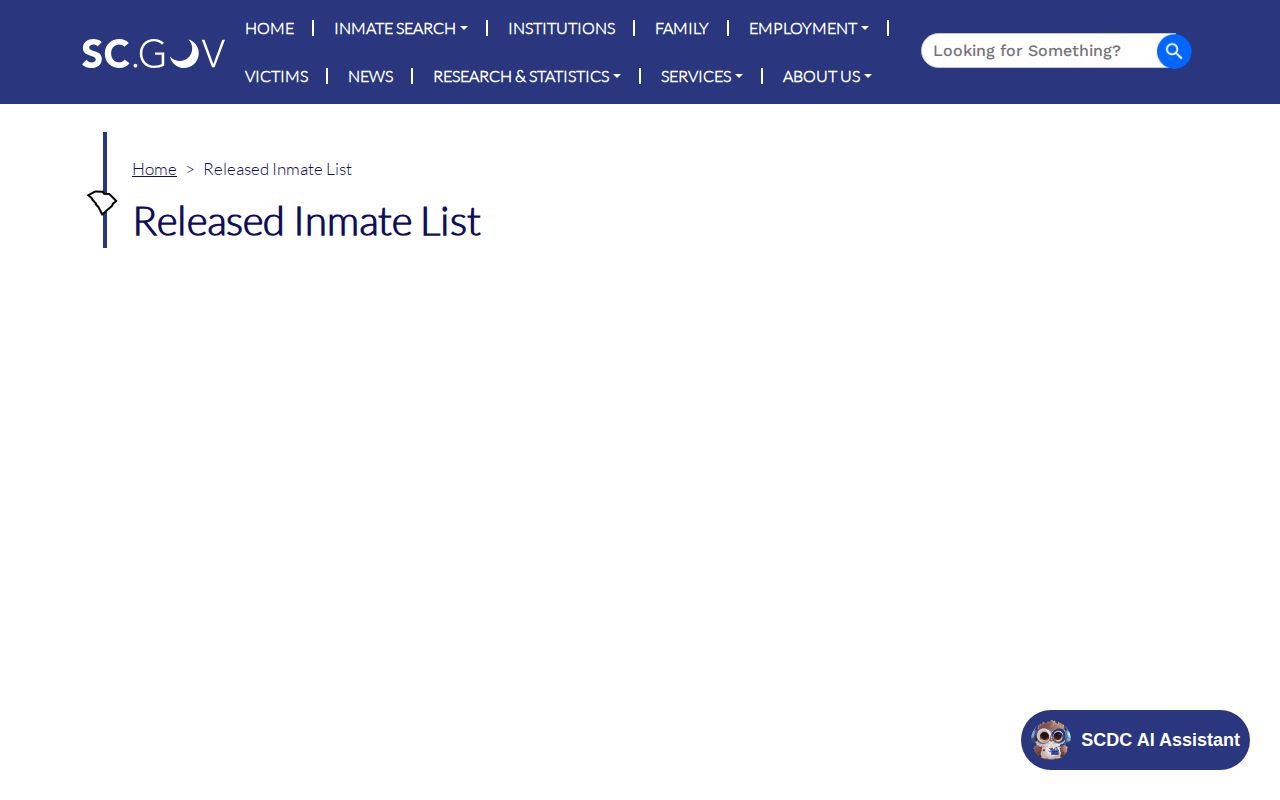
Use the result's exact date and release type, then check Parole / Probation if supervision may follow.
For a county detainee, ask CCDC whether the person physically departed, when processing ended, and whether the destination was the community or another agency. SC VINE can send a custody-change alert through the VINELink Release Check, but alert receipt time may differ from the event time. Preserve the alert and corroborate it.
Clarendon Release Calculator Limits
The public SCDC release-date calculator gives an earliest possible scenario. It assumes every possible good and work credit, cannot calculate the actual date for a person already sentenced, excludes Youthful Offender Act calculations, and omits complications such as other convictions. Turbeville houses many Youthful Offender Act prisoners, so that exclusion is especially relevant in Clarendon County.
The calculator's own limits are visible in the official SCDC calculator source.
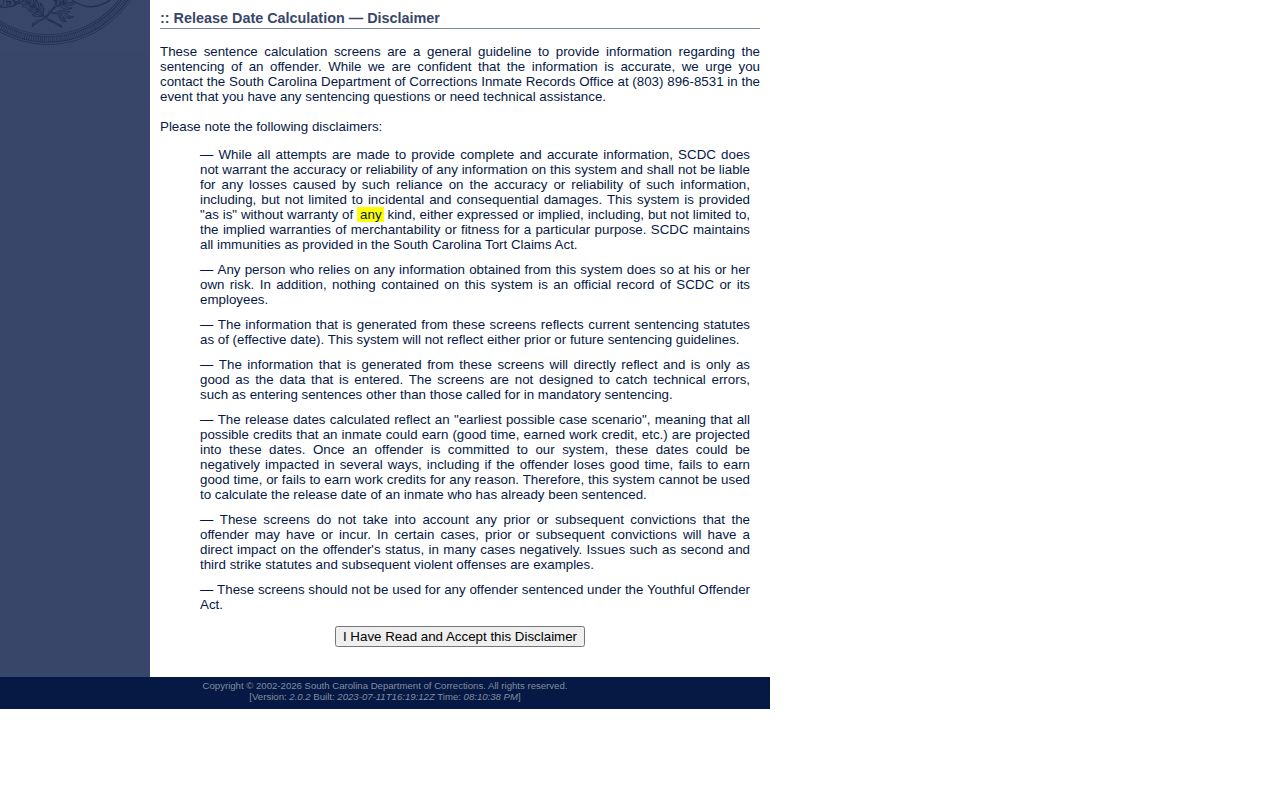
Use the tool to understand a hypothetical earliest case, never to replace Inmate Records or a completed release record.
Clarendon Release System Boundaries
Turbeville Correctional Institution is an SCDC prison in Clarendon County, while CCDC is a county jail. A transfer between SCDC institutions is continued state custody. A CCDC transfer to SCDC ends county possession but is not community release. Likewise, a court order can authorize release while a warrant or detainer redirects the person to another custodian.
Federal and immigration custody use other systems. A BOP release date concerns federal sentenced custody. ICE's locator addresses immigration detention. Neither supplies a CCDC or SCDC sentence computation. Confirm the custodian first, then use the date source tied to that system.
County and state records can also use similar words for different milestones. “Maxout” usually concerns the calculated end of a prison term. “Supervised reentry” identifies a form of community status rather than unconditional sentence completion. “Probation” in an SCDC released result can identify the release type, while the SCDPPPS record supplies the supervision detail. Preserve each agency's wording instead of converting all outcomes to “released free.”
For CCDC, a sentence-completion date still must be paired with the jail's all-charge review. Staff require authority covering each charge and check for warrants or detainers. The physical process can continue after the legal basis for release is received. Ask for the actual departure time and destination rather than assuming the scheduled end of a local term was the parking-lot exit time.
A records request can resolve a disputed calculation. For SCDC, identify the prisoner by SCDC ID and request the current computation sheet or releasable release-processing fields. For CCDC, provide the booking identifier, local sentence, and exact date range. Include the relevant court order if the dates appear inconsistent. Request electronic delivery and ask for an estimate before costly work begins.
Recheck the date after any new court entry, disciplinary decision, or agency transfer. State data can reflect the preceding day's update, while court and correctional systems may post on different cycles. Note when each source was viewed. That simple audit trail prevents an older screenshot or saved forecast from being mistaken for a live date.
Finally, distinguish release type from release place. SCDC results have included labels such as released, probation, and supervised reentry. Those terms describe the recorded event, but they do not necessarily name the gate, destination address, or end of all legal obligations. If the result points to supervision, contact the Clarendon SCDPPPS office. If it shows a detainer indicator, ask the responsible agencies whether the departure was a transfer. For a plain discharge, retain the completed date and type with the matching identifier.
Note: Only a completed release record confirms that a forecast became an actual departure.